
Why Every System Eventually Hits a Wall
Why Adding More Is Quietly Costing You More Than You Think

Why Every System Eventually Hits a Wall
At some point, more stops working. Most people never figure out exactly when that happens… or why. A great deal of suffering in today’s world comes from optimizing past the point of diminishing returns. It’s a concept taught in introductory economic classes, yet people from business leaders to W2 employees do not learn to apply it to other aspects of life that would serve us to be more efficient and productive.
If you’re not familiar, the law itself says, assuming all else is equal, if you keep adding more units of input to a process, eventually, the additional unit of input produces less output on a marginal basis than the one before it. The idea was formalized by David Ricardo in the early 1800s and used it as a cornerstone for his classical economic theory.
The cleanest example that I was taught is imagine that you open a pizza restaurant and you’re working by yourself. It’s difficult to work by yourself because your pizza is in high demand, so you’re only able to make 20 pizzas a day and you realize that your input of labor can only produce so many pizzas. Therefore, you hire another employee to help you with the pizza making process. Now, you can make twice as many pizzas as before, totaling 40 and having a marginal product of 20.
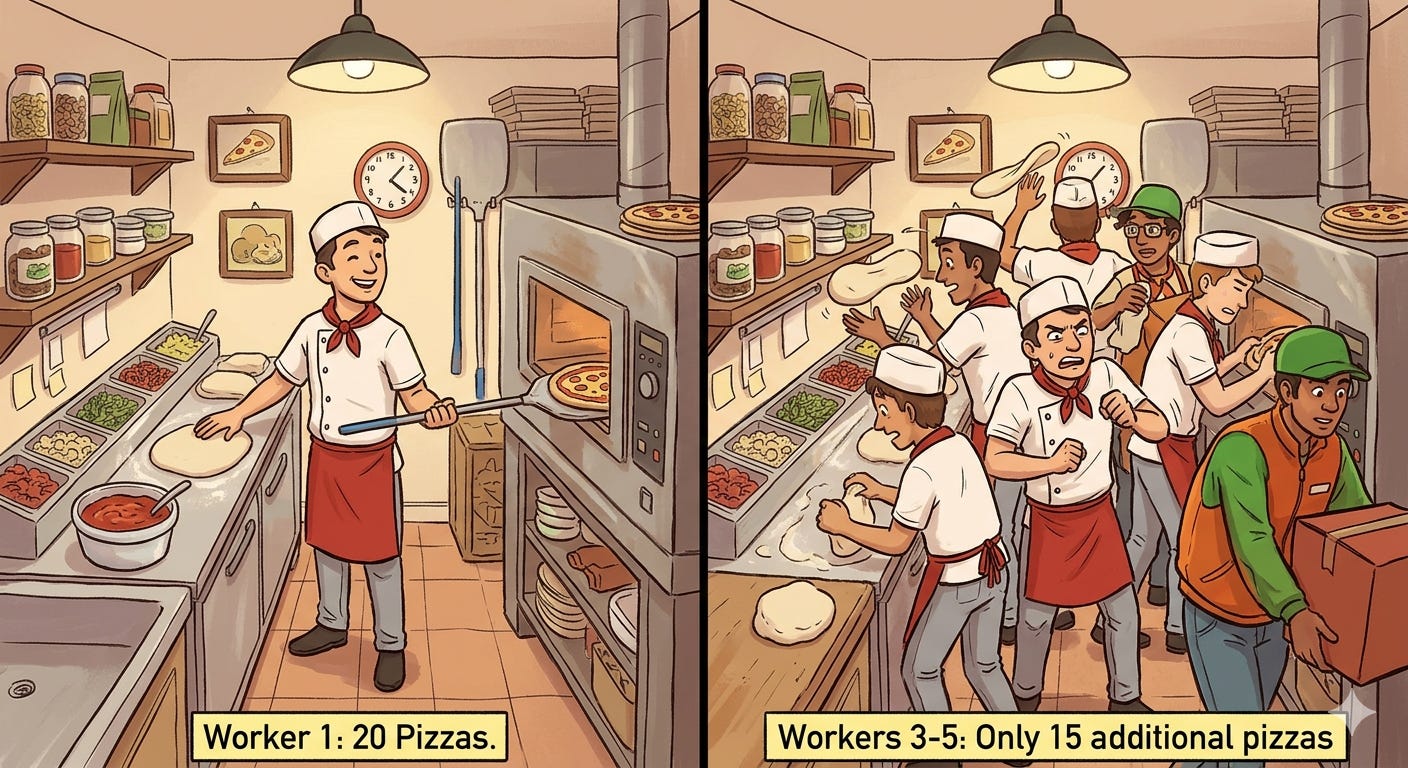
Still, you want to make more pizzas so you can make more money, so you hire a 3rd employee in total for the pizza shop. However, the kitchen isn’t that big and the 3rd employee is starting to crowd the kitchen. Even so, you’re able to produce more pizzas, this time, only 55 total pizzas, for a marginal product of 15. This happens until the marginal product (how much each additional worker can produce and is downward sloping) meets the marginal cost curve (how much each additional unit costs to produce and is upward sloping).
That compression of output with each additional worker is the law in its purest form. Diminishing returns exist everywhere. The more insightful idea is recognizing why this pattern is so universal.
Universality of the Law of Diminishing Returns
If something is a law, that means it must be universal, and that is the case here. Almost every system in nature and in human nature share the same basic architecture of having a fixed constraint that cannot be scaled infinitely.
Land.
Human Attention.
Biological Capacity.
Addressable Markets in business.
Organizational bandwidth and operations.
So, even though we learn the concept in economics, it isn’t constrained to just that field. It’s a systems law that defines society and the universe.
3 key examples in the following paragraphs will be applicable and valuable to your life.
The Market Cap Trap
A company’s growth is racing against itself.
The total addressable market for any company is capped once it reaches a certain size. At first, you’re taking control of uncontested ground with a new product, but as your market share grows, you must start fighting for customers with competitors, or, a new addressable market with different business segments. Both situations cause lower marginal returns over time.
The bureaucracy grows as the company becomes larger. As your company grows, more people need to be hired for communication, management, and compliance. As the firms scale, each new layer adds a complexity tax and more friction, displaying the law of diminishing returns.
Take the company Apple for example. Apple quickly grew from a 100B company to a 1T company from building smartphones and executing on an exceptional level. However, moving from 1T to 3T has been much more difficult, requiring Apple to capture nearly every user on earth and squeezing services into their existing client base. The next 1T, is always going to be more difficult to capture than the 1st T.
The broader implications for markets is significant.
Financial markets and analysts systemically and regularly misprice this when evaluating stocks. Investors believe current or past growth rates will continue into the future, which is why high-multiple stocks get crushed when growth disappears in the quarterly earnings reports.
The markets are constantly surprised by a law that has been well-established since the 19th century.
Where Wealth Stops Buying Wellbeing

This one hits hard for me and I think it can impact a lot of people who fully understand it. Money buys real improvements in wellbeing, especially at first when you come from nothing, but as you grow richer, the impact on your happiness diminishes with each additional dollar you make.
There is a mechanism called hedonic adaptation, more commonly known as lifestyle inflation, where the human brain is wired to treat new baselines as normal. So, when you make more money, you tend to believe this is the new baseline and you begin to make purchases with that money. With every purchase comes a burst of brief satisfaction that fades as your brain recalibrates and understands it as the new normal. You go on a vacation for the first time, it’s amazing. If you go on a vacation once a year, they are still great, but not as good as the first one. If you go every few months, they aren’t nearly as satisfying as they were when you started to go in the beginning.
Why is this important? Because we currently live in an economic system optimized to produce more income at the top of the wealth ladder, where marginal returns to wellbeing are the flattest, while undervaluing the bottom of the curve where returns are the steepest and make the largest impact.
It’s a coordination trap dressed up as prosperity.
The Brain Has a Budget
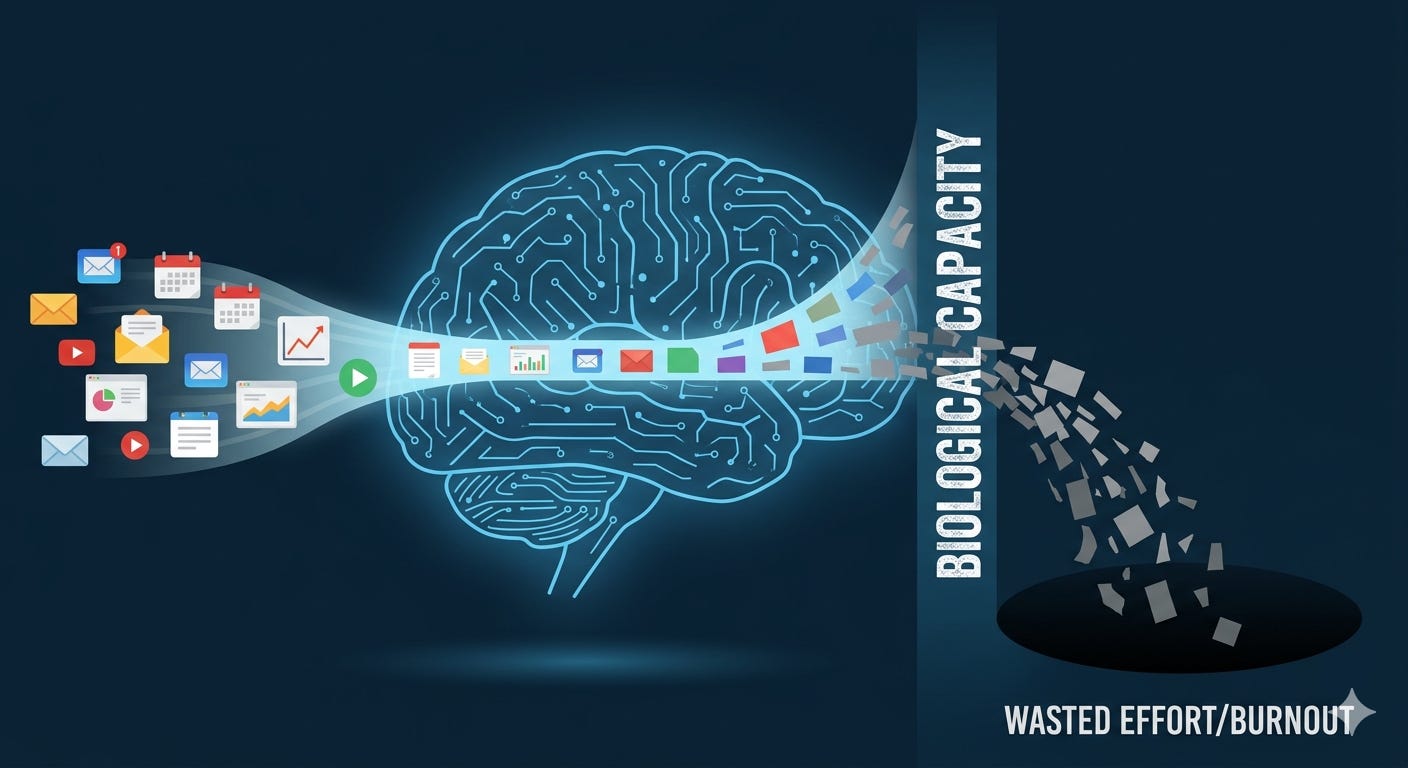
Modern work culture in the United States treats output and productivity linearly, when that is not the case for certain classes of business.
In 2019 Microsoft Japan ran an experiment that played with a 4-day workweek and reported a productivity boost of around 40%. It’s not because people worked harder during their shorter work week, but the removal of low-value activities allowed the employees to focus on what mattered most, and not get burnt out from doing so, which can lead to work that needs to be redone, creating negative marginal returns. Meaningless meetings were scrapped, time was more focused, and people enjoyed working more. When the barrier of clutter was removed, it gave people the freedom to work productively.
It certainly makes sense that a 40–60-hour work week was effective when the United States was built on industrial production where output is roughly linear with the hours worked. However, our economy has shifted from being a manufacturing superpower to a services-based nation that requires more mind than body.
The issue is that it becomes counterproductive to the success of the nation. The incentive structure never updated as technology did, so we collectively keep adding the input of labor past the point of diminishing returns because just showing up is easier to measure than the quality or quantity of cognitive related output.
Respecting the Curve
The goal isn’t to teach you an economic concept, it’s to teach you a new way of viewing the world. The real issue isn’t the law of diminishing returns, it’s the incentive structure that doesn’t consider the law and therefore creates inefficiencies, lack of productivity, and the wealth gap continuing to grow.
Take a few minutes to identify one area of your own life where you are adding inputs past the point of meaningful return. Where can you reallocate your energy that will produce the greatest results? What is the low hanging fruit? Optimize more, automate more, and spend your constrained time on this earth using it to the maximum productive capacity for your wealth, happiness, and wellbeing.
I explore these structural misalignments in depth in great detail in The American Nightmare. The financial and economic systems in American life aren’t just inefficient; they are structurally misaligned with widespread human flourishing.
If this way of thinking resonates, it’s what I do here.
Take the concepts that explain how systems actually work and show how they affect your life. If this way of thinking resonates, this is what I do here.
The American Dream is built on the premise that more is always better… more work, more growth, more wealth, more consumption. At some point more stops producing better. The nightmare begins when the system doesn’t acknowledge that and keeps demanding more anyway.